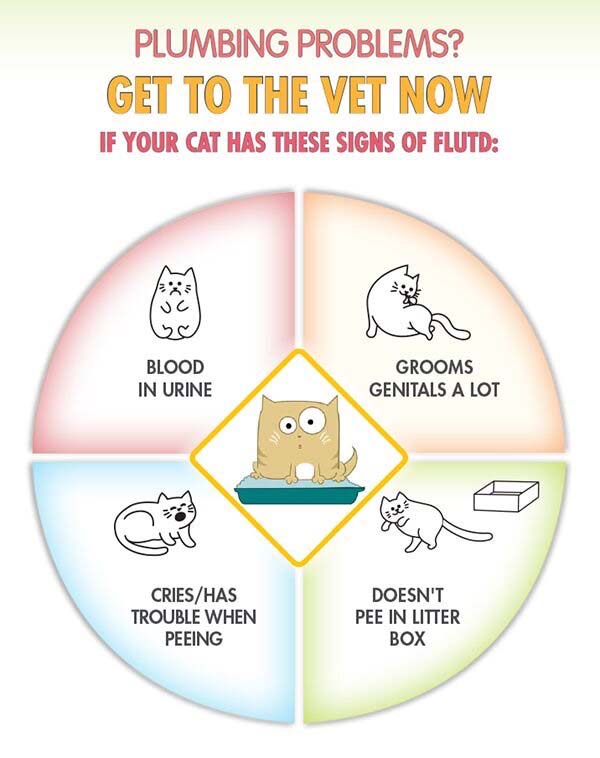
Feline lower urinary tract disease (FLUTD) describes a variety of conditions that affect the bladder and urethra of cats. Cats with FLUTD most often show signs of difficulty and pain while urinating (crying when they urinate), increased frequency of urination, sitting in the litter box, and blood in the urine. Cats with FLUTD also tend to lick themselves excessively and may urinate outside the litter box.
Cats with a urethral obstruction (a blockage in the urethra, which is the tube that carries urine from the bladder and out of the body) will also show these signs but will pass little or no urine and become increasingly distressed. Urethral obstruction is seen more often in male than female cats due their longer, narrow urethra. A urethral obstruction is an emergency and requires immediate veterinary treatment.
While FLUTD can occur at any age, it is usually seen in middle-aged cats. Cats that are overweight also have a higher risk. Factors such as emotional or environment stress, multi-cat households, and abrupt changes in daily routine may also increase the risk that a cat will develop FLUTD.
Infection of your cat’s urinary tract with bacteria can cause signs of FLUTD. Infections can be higher when the acid content (pH) and concentration of urine incorrect. Diet and water intake play a huge role in this as well as frequency of urination.
The most serious problem associated with urinary function is when a cat’s urethra becomes partly or totally blocked. These cats strain to urinate and produce little or no urine. It can appear that the cat is constipated and straining to pass stool but straining in the litterbox is more often a sign of urethral obstruction. Urethral obstruction is a potentially life-threatening condition caused either by urethral stones or by urethral plugs. (The latter are made of a soft material containing minerals, cells, and mucus-like protein.)
Once the urethra becomes completely blocked, the kidneys are no longer able to remove toxins from the blood or maintain a balance of fluids and electrolytes in the body. Without treatment, death frequently occurs when these imbalances lead to heart failure.
Treatment of this condition involves dislodging the obstruction, usually by flushing a sterile solution through a narrow tube placed into the urethra while the cat is sedated. Once the obstruction is removed, cats are usually placed on a catheter for 2–3 days. Dehydration and electrolyte imbalances are treated with intravenous fluid therapy. Antibiotics may be given to prevent or treat infection, and to help restore bladder function are sometimes recommended.
Feline idiopathic cystitis (FIC)—also called interstitial cystitis—is the most common diagnosis in cats less than ten years of age with lower urinary tract disease. The disease is not fully understood and may involve several body systems in addition to the urinary system.
Feline idiopathic cystitis is a diagnosis of exclusion, meaning that it is a diagnosis made after all diseases that might cause similar signs are ruled out. There is no specific diagnostic test for FIC. Stress and diet changes can increase the risk of FIC. As many as 40–50% of cats will have at least two episodes of FIC within one year. The disease can be chronic and very frustrating for the cat, the owner, and the veterinarian. The current goals of treating cats with FIC are to decrease the severity and frequency of episodes.
Here are some tips to help reduce the chances of recurrence.
First, feed small meals on a frequent basis. Consult with your vet about the best diet for your cat. Most urinary conditions respond better to specialised diets such as Hills C/D Stress and Royal Canine Urinary S/O. These diets can safely be fed to all the cats in the household if feeding separately is not practical. There are also supplements such as Furinaid that provide nutritional support for cats suffering from FIC. This helps the inside layer of the bladder.
Second, provide clean, fresh water at all times. Provide an adequate number of litter boxes (usually one more than the number of cats in the household) with the type of litter that the cat prefers.
Third, keep litter boxes in quiet, safe areas of the house. Keep litter boxes clean. They should be scooped twice a day and the litter changed at least weekly.
Fourth, minimise major changes in routine.
Fifth, reduce stress.